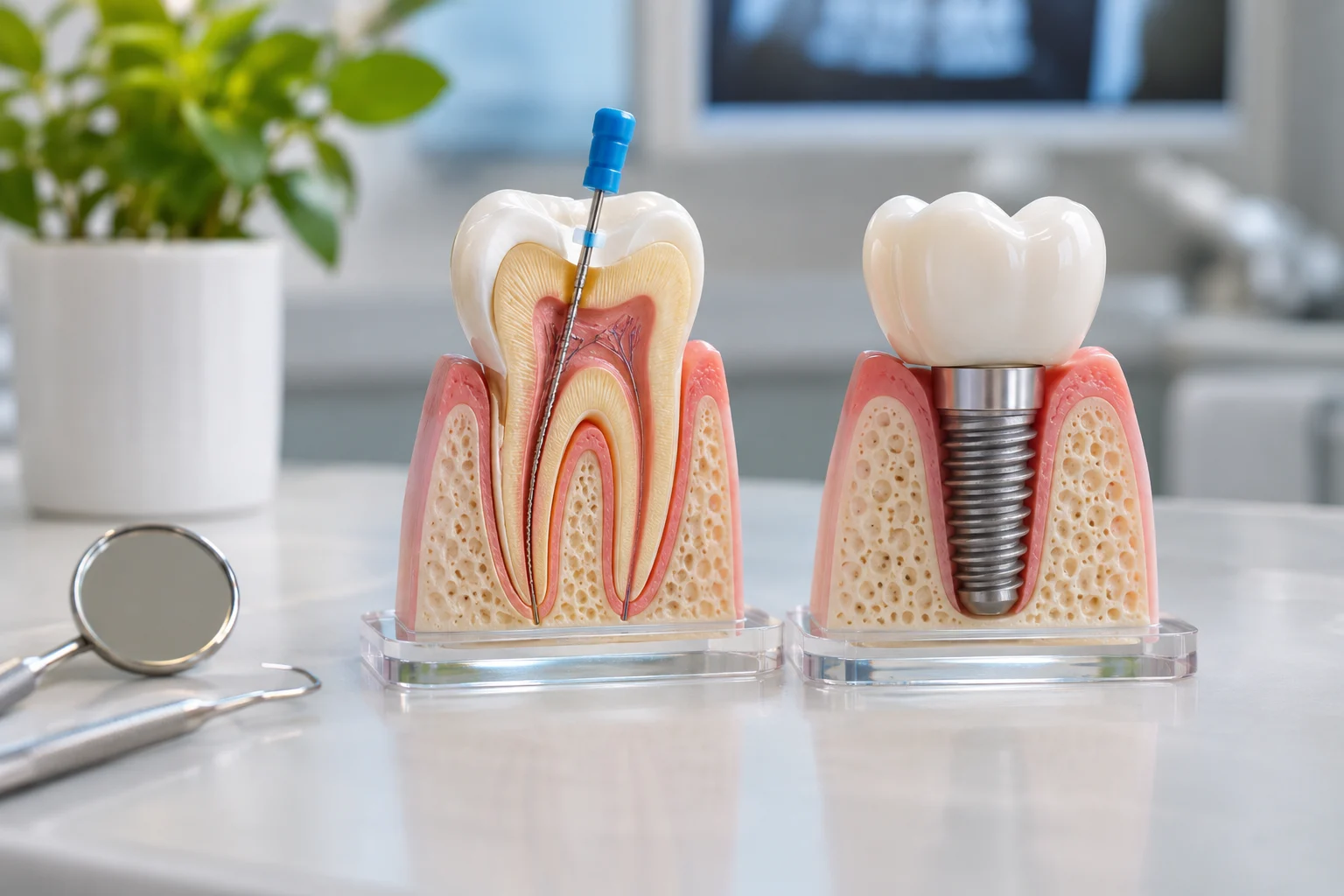
A tooth that aches, cracks, or throbs at night leaves you with a hard question. Do you keep it with a root canal, or remove it and replace it with a dental implant?
The short answer is that a root canal saves the tooth you have, while an implant replaces a tooth that cannot be saved. Which one applies to you depends on how much healthy tooth structure remains, how much bone supports it, and what your dentist finds on the exam and imaging.
Patients looking into dental implants often arrive with this exact question. Our office is at 5021 Mowry Ave in Fremont, and this guide walks through how the decision is usually made so you know what to expect before you sit in the chair.
What Is the Difference Between a Root Canal and a Dental Implant?
A root canal is a procedure that removes infected or inflamed pulp from inside your tooth, cleans the canals, and seals them. The tooth stays in your mouth and is usually protected with a crown afterward.
A dental implant is a titanium post placed in the jawbone to act as an artificial root. After healing, an abutment and a custom crown are attached on top. It is a replacement for a tooth that is already missing or has to be removed.
So these two treatments are not really competitors on the same problem. One keeps your natural tooth. The other steps in when the natural tooth is beyond repair.
According to the American Association of Endodontists, saving a natural tooth is generally preferred whenever it can be done, because a natural tooth helps preserve your bite and the bone around it.
When Can a Root Canal Save Your Tooth?
A root canal is often the right call when the damage is inside the tooth but the outer structure and the root are still sound. Our overview of root canal treatment explains the procedure in more detail.
Situations where saving the tooth is commonly possible include:
- Deep decay that has reached the nerve but left enough healthy tooth above the gumline.
- An infection or abscess at the root tip while the surrounding bone is still intact.
- A tooth that has been injured or cracked in a way that exposed the pulp but did not split the root.
- A tooth with lingering sensitivity to hot and cold that does not settle down.
If you are wondering whether your symptoms point this way, our guide on signs you may need a root canal covers the warning signs to watch for.
Keeping your own tooth also means your neighboring teeth are left alone. Nothing needs to be shaped or moved to make room.
When Is a Dental Implant the Better Choice?
Some teeth cannot be saved no matter how skilled the treatment is. In those cases, removing the tooth and placing an implant gives you a stable replacement that works like a natural root.
An implant is usually recommended when:
- The tooth has a fracture that runs below the gumline or splits the root.
- Decay has destroyed so much of the tooth that nothing is left to hold a crown.
- The bone supporting the tooth has been lost to advanced gum disease.
- A previous root canal has failed and the tooth cannot be treated again.
- The tooth is already missing.
When removal is needed, the first step is a tooth extraction. If the bone in that spot has thinned, bone grafting may be added so the implant has something solid to anchor into. This can lengthen the overall timeline, so it helps to plan for it early.
A single missing tooth is often handled with a single tooth implant, which stands on its own and does not rely on the teeth beside it.
Root Canal vs Dental Implant: Comparing the Two Side by Side
Treatment Time
A root canal is usually completed in one or two visits, followed by a crown. An implant takes longer because the post needs several months to bond with the jawbone before the final crown is placed. If grafting is needed first, add more healing time. You can read the full sequence in our guide to the dental implant process.
Comfort
Both procedures are done with local anesthesia, and sedation can be discussed if you feel anxious. Soreness after a root canal tends to be mild and short. After implant surgery, expect some swelling and tenderness for a few days, which your dentist will help you manage.
Longevity
A root canal tooth with a well fitted crown can last many years with good care. Implants are also designed for long service, and results depend on gum health, bite forces, and how well you clean around them. Our article on how long dental implants last goes through the factors that matter most.
Effect on Neighboring Teeth
A root canal leaves your other teeth untouched. An implant also stands independently, which is a real advantage over replacing a tooth with a bridge that needs support from adjacent teeth.
How Does Your Dentist Decide Which Option Fits?
The decision comes down to a careful exam rather than a rule of thumb. Your dentist looks at the tooth, the gums, and the bone underneath it.
Three things carry the most weight:
- How much healthy tooth structure is left above the gumline to support a crown.
- Whether the root is intact or fractured.
- How much bone and gum health surround the tooth.
Detailed imaging makes this much clearer. A 3D cone beam scan shows the shape of the roots, the condition of the bone, and the position of nearby structures, which helps your dentist recommend a path with confidence instead of guessing.
Your overall health and personal goals matter too. Some patients want to keep their own tooth at nearly any cost, and others prefer a single definitive solution. Both preferences are worth discussing openly.
Is a Root Canal or an Implant More Painful?
Most patients are surprised by how manageable both procedures are. The pain that sends people to the dentist usually comes from the infection or damage itself, not from the treatment that relieves it.
A root canal often brings relief from the toothache that was there before. Implant placement involves a surgical site, so swelling and tenderness are more noticeable in the first few days. Our guide to dental implant recovery describes what the healing period usually looks like.
How Do the Costs Compare?
A root canal with a crown generally costs less up front than an implant, because an implant involves surgery, several components, and more appointments. That said, the real comparison should include everything the tooth will need over the years, such as retreatment, a crown, or a later replacement.
Your own costs depend on the tooth, any extraction or grafting, and your dental plan. Coverage for root canals and implants is often handled differently, so it is worth asking about your benefits before treatment starts. You can review the factors that shape pricing on our dental implant cost page, and we will go over a written estimate with you after your exam.
Can a Root Canal Fail?
Sometimes, yes. A tooth treated with a root canal can become reinfected if bacteria find a way back in, for example through a cracked crown or a missed canal. Many of these teeth can be retreated successfully.
If retreatment is not possible, or the root has fractured, an implant becomes the next step. Having a root canal first does not close the door on implants later.
What If the Tooth Is Already Missing?
Then the question changes. You are no longer deciding whether to save the tooth. You are choosing how to replace it.
The common options are an implant, a bridge, or a partial denture. Our comparison of implants versus bridges lays out the differences, and the overview of single tooth replacement options covers the full range. If a bridge is on your list, you can also read about dental crowns and bridges.
What Should You Do If Your Tooth Hurts Right Now?
Do not wait for the pain to pass. A damaged nerve or an infection rarely resolves by itself, and the longer a problem sits, the fewer options you tend to have.
Call the office as soon as you can. If you have swelling in your face, a fever, or severe pain, treat it as urgent and read our guidance on when to call an emergency dentist. You can also learn how we handle emergency dental care visits.
Plan Your Next Step With Fremont Star Dental
Choosing between a root canal and an implant should not feel like a gamble. With a proper exam and 3D imaging, Dr. Uma Patel and the team can show you what is happening with your tooth and walk through the options that fit it.
Patients from Milpitas visit us at 5021 Mowry Ave in Fremont. Call (510) 797-4900 or book online to start the conversation, and take a look at our page on dental implant care for Milpitas patients if you would like to learn more about replacing a tooth.
FAQs on Root Canal vs Dental Implant
Q1: Is a root canal better than an implant?
A: When a tooth can be saved, keeping it with a root canal is generally preferred. When the tooth is too damaged, fractured below the gumline, or has lost its bone support, an implant is usually the better path.
Q2: Which lasts longer, a root canal or a dental implant?
A: Both can last many years with good care. A root canal tooth depends on a well fitted crown and healthy gums, and an implant depends on bone health and cleaning habits. Your dentist can discuss what to expect for your situation.
Q3: Can I get an implant instead of a root canal?
A: In some cases, yes, but it means removing a tooth that might have been saved. Your dentist will usually recommend keeping the natural tooth if it has a good outlook.
Q4: Does a root canal hurt more than an implant?
A: Neither is usually described as very painful with modern anesthesia. A root canal often relieves existing pain, while implant surgery brings swelling and tenderness for a few days afterward.
Q5: What happens if a root canal fails?
A: Your dentist may be able to retreat the tooth. If the tooth is fractured or cannot be retreated, it may be removed and replaced with an implant.
Q6: Can you get an implant after a root canal?
A: Yes. If the treated tooth later fails or cracks, it can be removed and an implant can be planned once the area is evaluated and, if needed, grafted.
Q7: Is it cheaper to get a root canal or an implant?
A: A root canal with a crown usually costs less up front. The total cost over time depends on the tooth, the care it needs afterward, and your insurance coverage.
Q8: How do I know whether my tooth can be saved?
A: An exam and imaging are the only reliable way to tell. Your dentist checks the amount of healthy tooth, the condition of the root, and the surrounding bone before recommending a plan.