.svg)

.svg)
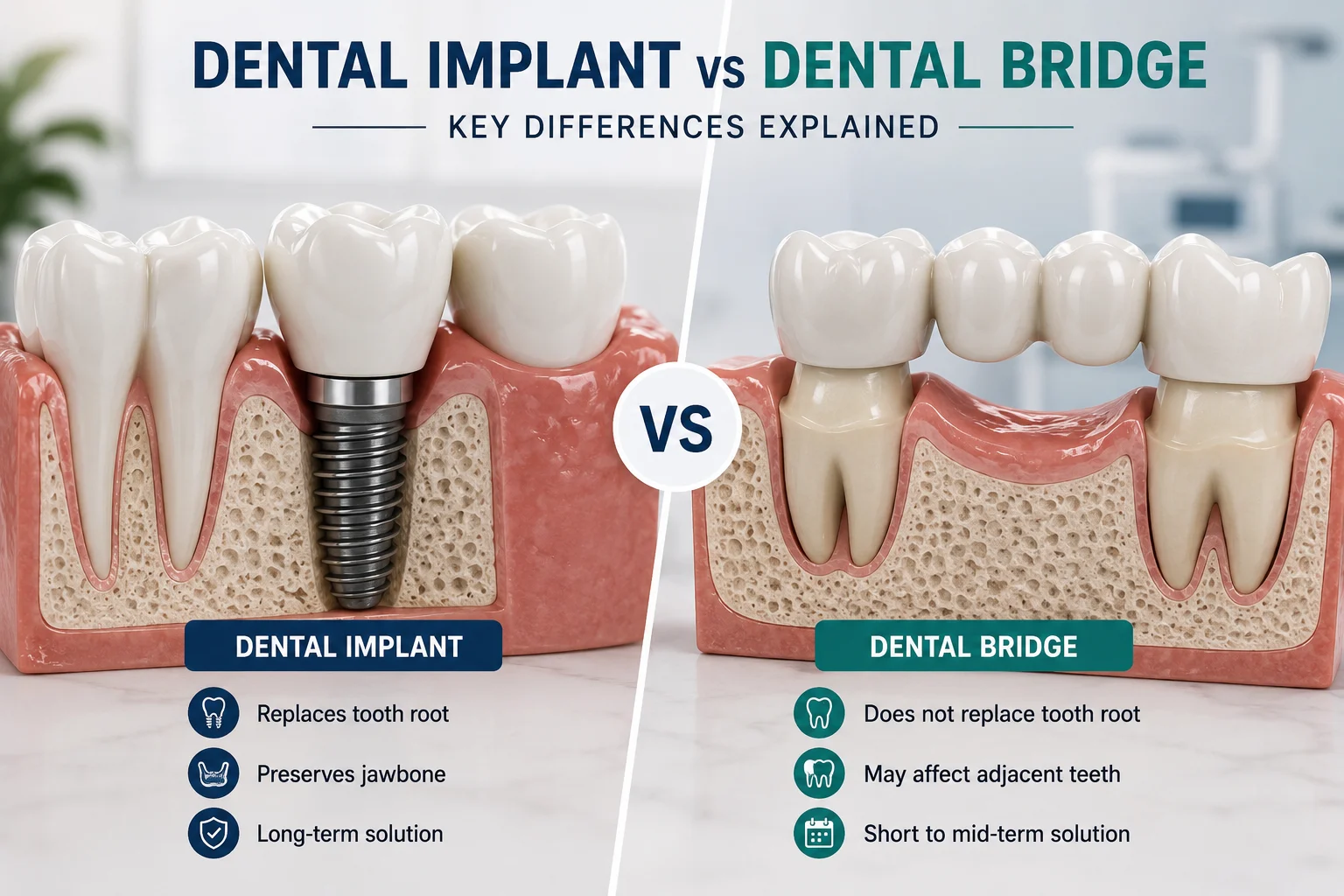
Losing a tooth can feel like a major setback, affecting not just your ability to chew and speak comfortably, but also your willingness to smile openly. Whether it happened due to severe decay, unexpected physical trauma, or a structural fracture, dealing with an empty space in your mouth is a deeply personal and frustrating challenge.
When you decide to reclaim your oral health, you will find that modern restorative dentistry offers two highly reliable solutions: dental implants and dental bridges. Both options can successfully fill the empty gap and restore your confidence, but they do so using completely different structural engineering and clinical techniques.
Choosing the right path for your mouth requires weighing several factors, from the long-term health of your jawbone to your personal lifestyle budget. At Fremont Star Dental, we know that making a big decision about your teeth can feel overwhelming. Let us walk through the key differences between a dental implant and a dental bridge, so you can choose the absolute best path forward with an experienced dentist.
Structural Engineering: How Each System Works
To understand which tooth-replacement option is ideal for you, it helps to understand how each restoration is structurally built and supported inside your mouth.
The Independent Architecture of Dental Implants
A dental implant is designed to mimic the natural anatomy of a real tooth, replacing both the visible crown and the invisible root beneath the gums. The procedure involves surgically placing a small titanium post directly into your jawbone. If you're considering dental implant treatment, understanding this process can help you make a confident decision. Over the course of a few months, your bone naturally fuses with the titanium in a process called osseointegration.
Once this solid foundation is fully healed, an connector piece known as an abutment is attached to the post, and a custom porcelain crown is permanently screwed or cemented on top. Because it is anchored directly into the bone, an implant stands entirely on its own without needing assistance from surrounding teeth.
The Team Approach of a Dental Bridge
A traditional dental bridge works exactly like its name implies: it bridges the gap created by one or more missing teeth. Instead of anchoring into the jawbone, a bridge relies on the support of the healthy teeth on either side of the empty space. These adjacent teeth are clinically referred to as abutment teeth.
To create a bridge, your dentist will custom-craft a single, connected prosthetic unit consisting of two dental crowns on the ends with a solid artificial tooth, known as a pontic, suspended in the middle. The entire unit is permanently cemented over your prepared natural teeth, using them as sturdy anchor posts to hold the replacement tooth aloft. Learn more about dental crowns and bridges and how they restore missing teeth.
Preserving Your Natural Tooth Structure and Enamel
One of the most critical differences between these two restorative choices lies in the long-term physical impact they have on the remaining healthy teeth in your mouth.
The Conservative Nature of Implants
Because a dental implant is an independent structure that integrates directly into your jawbone, it leaves your surrounding natural teeth completely untouched. There is no need to alter, grind down, or modify the teeth next to the empty gap. This allows you to preserve your healthy, intact enamel across the rest of your smile.
The Alterations Required for a Bridge
To place a dental bridge, the teeth on either side of the space must be permanently reshaped and shaved down to fit the anchoring crowns. Even if those neighboring teeth are perfectly healthy, free of decay, and completely straight, a significant portion of their protective enamel must be removed. For many patients, sacrificing healthy tooth structure to fix an adjacent missing space is a major drawback.
Protecting and Maintaining Your Jawbone Health
Beneath your visible smile lies a complex foundational matrix of bone tissue that requires physical stimulation to remain strong, dense, and healthy.
Preventing Bone Loss with Implants
When you chew food, the root of a natural tooth sends microscopic physical vibrations down into your jawbone. This constant stimulation signals to your body that the bone tissue is still actively needed, keeping it dense and strong. When a tooth is lost, that stimulation vanishes, and the surrounding bone naturally begins to dissolve and resorb over time.
Because a titanium implant replaces the missing root, it continues to provide that essential physical stimulation to your jaw. This actively prevents bone loss, preserves your natural facial structure, and keeps your jawline from developing a hollow, aged appearane. These are some of the long-term benefits of dental implants that make them a preferred tooth replacement op
The Bound Boundary of a Dental Bridge
While a dental bridge fills the empty space above your gums beautifully, it does nothing to replace the root beneath the surface. The artificial pontic simply hovers over your gumline. Because the underlying jawbone receives no physical stimulation in that specific area, the bone beneath a bridge will naturally shrink and resorb as the years go by. Over time, this can lead to a visible gap forming between the bottom of your prosthetic tooth and your changing gumline.
Longevity, Durability, and Daily Oral Hygiene
Investing in your smile is a lifetime commitment, and understanding the daily maintenance and long-term durability of each option is vital for your peace of mind.
Lifetime Durability and Simple Care for Implants
Titanium is an exceptionally bio-friendly, robust material that is completely immune to tooth decay. Once an implant successfully integrates with your bone, it can easily last for the rest of your life with excellent care.
Furthermore, maintaining a dental implant is exactly like caring for a natural tooth. You can brush it normally and slip standard dental floss easily between the teeth to clean your gums.
The Lifespan and Specialty Cleaning of a Bridge
A high-quality dental bridge is exceptionally strong and durable, typically lasting anywhere from ten to fifteen years before natural wear and tear requires a replacement. However, because the artificial tooth is physically fused to the neighboring crowns, you cannot pass standard dental floss down between them.
Cleaning a bridge requires specialized tools, such as floss threaders, interdental brushes, or water flossers, to clear away trapped food particles from beneath the suspended pontic. If oral hygiene is neglected, bacteria can easily creep under the margins of the crowns, causing cavities to form on the supporting anchor teeth.
Time and Financial Investments: Upfront vs. Long-Term Value
For many busy patients, balancing the immediate timeline of a treatment with their current financial budget plays a major role in their decision-making process.
The Gradual Journey of Implant Therapy
Getting a dental implant requires patience. Because the titanium post needs time to fuse securely with your jawbone, the entire multi-step process can span anywhere from three to six months or longer if you require a preliminary bone graft. It also represents a higher upfront financial investment per tooth, which can sometimes stretch a patient's immediate budget.
The Fast Turnaround of a Dental Bridge
If you need to quickly restore your smile for an upcoming life event, a dental bridge is incredibly efficient. The entire procedure is typically completed in just two simple visits spanning a couple of weeks. There is no surgical healing phase required. Additionally, a bridge usually carries a lower upfront cost than an implant, making it a highly accessible short-term option. However, because a bridge will likely need to be replaced at least once or twice over your lifetime, the long-term cumulative costs can eventually surpass the one-time investment of a permanent implant.
Take the First Step Toward a Complete Smile: Contact Fremont Star Dental Today
Reclaiming your smile after losing a tooth is one of the most rewarding investments you can make for your health, presentation, and self-esteem. If you're missing several or all of your teeth, full mouth dental implants may provide a stable, long-lasting solution to restore your smile and oral function. Whether you choose the ultra-conservative, permanent longevity of a dental implant or the fast, efficient reliability of a traditional dental bridge, the secret to a successful transformation is working with an experienced team that genuinely listens to your goals.
At Fremont Star Dental, we pair state-of-the-art clinical technology with a warm, compassionate approach to deliver personalized solutions that look, feel, and function just like natural teeth. As a premier dentist in Fremont, CA, we are dedicated to helping you feel completely informed and comfortable every single step of the way. Contact us today to schedule your comprehensive restorative consultation, and let us help you rediscover the freedom of a complete, confident smile.
Frequently Asked Questions Comparing Implants and Bridges
Is the dental implant surgery painful?
Not at all. The surgical placement of an implant post is a highly controlled, precise procedure performed under deep local anesthesia. The bone tissue itself lacks pain-sensing nerves, so most patients report that the sensation is much gentler than a routine tooth extraction. You may experience some mild soreness and light swelling in your gum tissue for a few days following the appointment, which can easily be managed with over-the-counter pain relievers.
Can a dental bridge be converted into an implant later?
Yes. If you currently wear a dental bridge and decide down the road that you want the permanent stability and independent support of a dental implant, it is often possible to make the switch. Your dentist can carefully remove the old bridge, place an implant post into the empty space, and protect the old anchor teeth with individual porcelain crowns. If significant bone loss has occurred beneath your old bridge, a simple bone graft can be performed first to rebuild the foundation.
How do I know if my gums are healthy enough for an implant or a bridge?
A successful restorative treatment relies entirely on a clean, disease-free foundation. Before starting either procedure, your dentist will thoroughly evaluate your gums for any signs of periodontal disease. If you suffer from active gum inflammation or bleeding gums, your team will prioritize treating the underlying infection first, ensuring your soft tissues are completely stable and ready to support your new smile.
Does dental insurance cover the cost of tooth replacement?
Because replacing a missing tooth is essential for your overall health, speech, and digestive chewing function, most dental insurance policies provide restorative benefits for both implants and bridges. Coverage percentages vary depending on your specific plan provider. Our helpful front office team is always available to help you look over your benefits, maximize your yearly insurance limits, and explore flexible monthly financing options to fit your family budget.
Can a dental implant or bridge replace multiple missing teeth?
Yes. Both dental implants and dental bridges can replace multiple missing teeth, but the ideal solution depends on the number and location of the missing teeth. An implant-supported bridge can often replace several teeth without requiring an implant for every missing tooth, while a traditional bridge is best suited for replacing one or a few consecutive teeth when healthy supporting teeth are available. Your dentist will recommend the most appropriate option based on your oral health and treatment goals.
Which option looks and feels more like a natural tooth?
Both dental implants and modern dental bridges are custom-designed to blend seamlessly with your natural smile. However, dental implants generally provide the most natural look and feel because they are anchored directly into the jawbone, closely mimicking the function of a natural tooth root. This added stability allows patients to chew, speak, and smile with greater confidence.
Who is a good candidate for a dental implant?
Most healthy adults with one or more missing teeth are good candidates for dental implants. You should have healthy gums and sufficient jawbone to support the implant. Even if you've experienced some bone loss, procedures such as bone grafting can often make implant treatment possible. During your consultation, your dentist will evaluate your oral health, medical history, and bone density to determine if implants are the right choice for you.
What happens if I leave a missing tooth untreated?
Leaving a missing tooth untreated can lead to several long-term oral health problems. Nearby teeth may gradually shift into the empty space, causing bite misalignment and making it more difficult to clean your teeth properly. Over time, the jawbone beneath the missing tooth can also deteriorate due to lack of stimulation, potentially affecting your facial appearance and making future tooth replacement more complex. Replacing a missing tooth promptly helps preserve your oral health and prevents these complications.