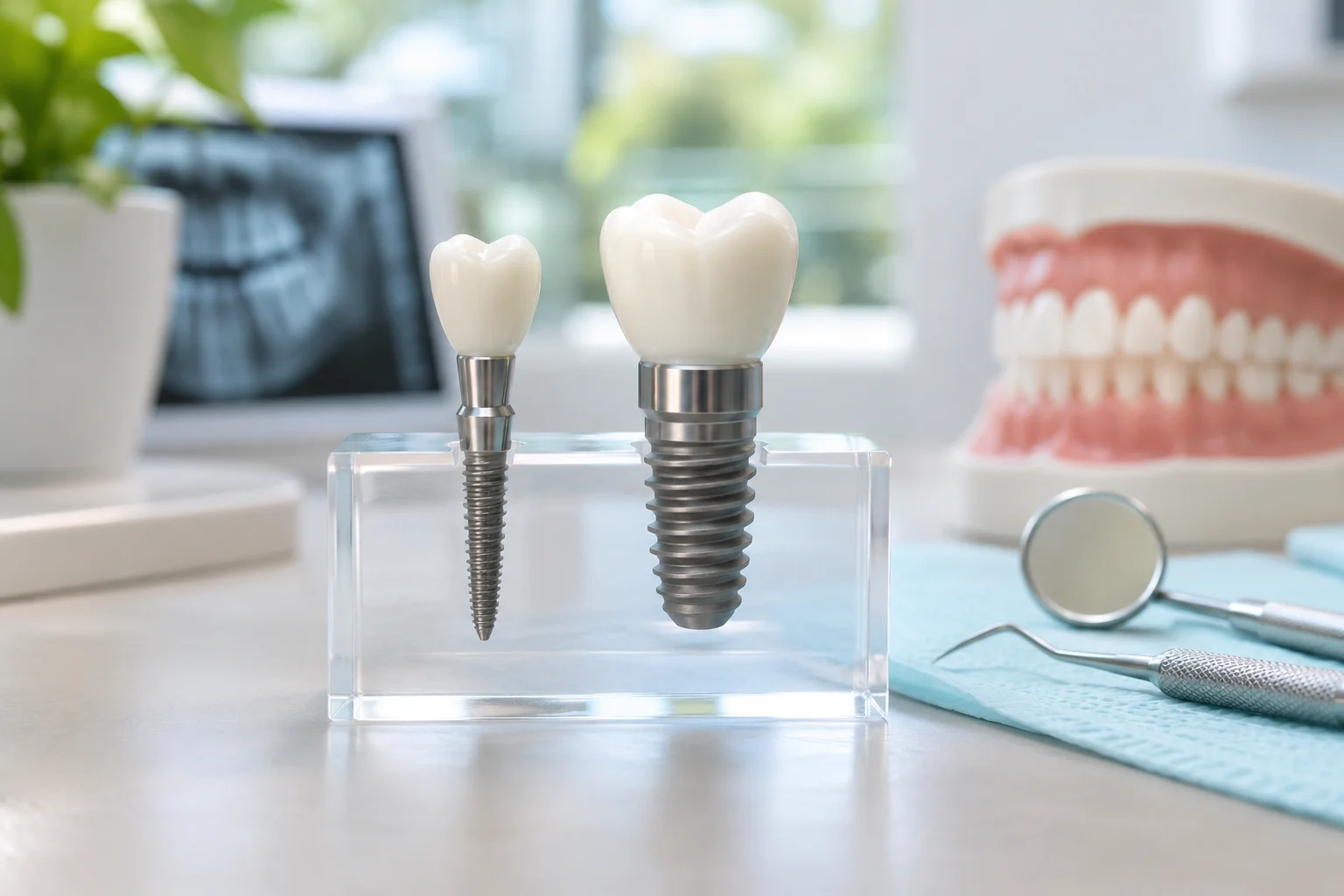
If you are missing a tooth and have started reading about implants, you have probably noticed two names popping up: mini dental implants and traditional implants. They look similar on a diagram, but they are not interchangeable.
The main difference is size. Mini implants are narrower posts, generally under 3 mm wide, while traditional implants are wider and built to carry the heavier forces of everyday chewing. That single detail affects how much bone you need, how the procedure goes, and which teeth each type suits best.
Many people exploring dental implants ask us which type is better. The honest answer is that it depends on your jawbone, your bite, and what you want the implant to do. This guide explains each option so you can walk into your consultation with clear questions.
What Are Mini Dental Implants?
Mini dental implants are small titanium posts placed in the jawbone to replace a tooth root or to hold a denture steady. Because they are slimmer, they can fit into spaces where a wider post would not.
According to Healthline, mini implants have been in use for roughly 20 years, which means the long term research behind them is more limited than the decades of data available for traditional implants. That does not make them a poor choice, but it is worth knowing when you compare options.
At Fremont Star Dental, mini implants are one of the options we discuss for patients whose bone density is limited.
What Are Traditional Dental Implants?
Traditional implants are the standard choice most people picture when they think of a dental implant. A wider titanium post is placed in the jawbone, given time to bond with the bone, and then topped with an abutment and a custom crown.
The wider post gives the crown a broad, stable base. That is why traditional implants are commonly used for single teeth, several teeth, and as anchors for full arch restorations. Our guide to the dental implant process shows how placement and healing usually unfold.
Mini vs Traditional Implants: The Main Differences
Size
Traditional implants are generally somewhere between 3.25 and 5 mm in diameter, while mini implants are typically 3 mm or less. A few tenths of a millimeter sounds small, but it changes how much surface area is in contact with the bone.
Bone Requirements
Mini implants can sometimes be placed where the bone is thinner, and in some cases a graft can be avoided. Traditional implants usually need more bone width and depth, and a patient with bone loss may need preparation first.
Procedure and Healing
Because mini implants are narrower, the placement is often less invasive, and some patients find recovery easier. Traditional implants involve a slightly larger site, and the healing period before the final crown is typically a few months. Your dentist will give you a timeline based on your own case.
Strength and Chewing Load
This is where traditional implants have the edge. A wider post spreads biting forces over a larger area, which is why it is the usual choice for back teeth that do the heaviest chewing. A mini implant carries less load, so placement and the number of implants used become more important.
Longevity
Traditional implants have the longest track record. Mini implants are intended to last as well, but the available research covers a shorter period. Your oral hygiene, bite habits, and gum health will affect either type. Our article on how long dental implants last covers the details.
When Might Mini Implants Make Sense?
Mini implants can be a good fit in a few specific situations:
- You have limited bone width or density and want to avoid a more extensive graft where possible.
- You wear a lower denture that moves around and want it to feel more secure.
- You are replacing a small front tooth where there is not much space between the roots of the neighboring teeth.
- You want a less invasive option and your dentist confirms that your bite can support it.
Denture wearers in particular often ask about this route. Our comparison of implant supported and traditional dentures shows what changes in comfort and stability.
When Are Traditional Implants the Better Fit?
Traditional implants are usually the first recommendation when:
- You are replacing a molar or premolar that handles strong chewing forces.
- You have enough healthy bone, or you are willing to build it with a graft.
- You clench or grind your teeth.
- You want the option with the longest research history.
They are also the foundation for larger restorations.
Who Should Not Get Mini Implants?
Mini implants are not for everyone. Healthline and other clinical sources point to a few groups who are generally poor candidates, including:
- Children and teens whose jaws are still developing.
- People who grind their teeth heavily.
- People with severe bone loss, since even a mini implant needs some bone to hold it.
- Patients with certain health conditions, such as uncontrolled diabetes or clotting disorders.
- Smokers, and patients taking blood thinners, depending on the circumstances.
This list is a starting point, not a verdict. Your dentist will review your medical history and examine your mouth before recommending any type of implant.
How Does Your Dentist Choose Between Them?
The choice comes from your exam and imaging. We look at bone width, bone height, the location of the missing tooth, how you bite, and your overall health.
A 3D cone beam scan gives a detailed view of your jawbone and nearby structures, which makes it easier to plan placement and decide whether a mini or traditional implant is realistic. If you want a deeper look at what qualifies someone for treatment, read our guide on whether you are a good candidate for dental implants.
Does the Type of Implant Change the Cost?
It can. Mini implants may involve a simpler procedure, but the full cost depends on how many implants you need, whether grafting is required, and what restoration goes on top. A lower price for the post alone does not always mean a lower total.
The most reliable way to compare is to ask for a written estimate for each option after your exam. You can see what affects pricing on our dental implant cost page. Insurance coverage varies by plan, so check your benefits as well.
How Do You Care for Either Type of Implant?
Both types need the same daily habits. Brush twice a day, clean between the teeth and around the implant every day, and keep up with regular checkups and cleanings.
Gum health matters a great deal. Problems around an implant usually start with plaque and inflammation in the surrounding tissue, which is one reason neglected hygiene is linked to trouble later on. Our article on the main reason dental implants fail explains what to watch for and how to protect your investment.
Planning Your Implants as a Union City Patient
The right implant is the one that fits your bone, your bite, and your goals, not the one with the shortest name or the lowest sticker price. A careful consultation with imaging will tell you which path makes sense.
Patients from Union City visit Fremont Star Dental at 5021 Mowry Ave in Fremont. Call (510) 797-4900 or book online, and visit our page for dental implant services for Union City patients to see how treatment is planned from the first visit.
FAQs on Mini vs Traditional Dental Implants
Q1: What is the difference between mini and traditional dental implants?
A: Mini implants are narrower, generally under 3 mm in diameter, while traditional implants are wider and designed to handle heavier chewing forces. The size affects bone requirements, placement, and the teeth each type suits best.
Q2: Are mini implants as strong as traditional implants?
A: A traditional implant spreads biting force over a larger post, so it is generally preferred for back teeth. Mini implants can work well in the right situation, but they carry less load.
Q3: Do mini implants need bone grafting?
A: Often less than traditional implants, because they can fit in thinner bone. However, they still need some bone to anchor them, and severe bone loss can rule them out.
Q4: How long do mini implants last?
A: With good hygiene and regular checkups they are intended to be long lasting, but they have a shorter research history than traditional implants, so exact lifespan is harder to predict.
Q5: Are mini implants cheaper than traditional implants?
A: They can cost less per post, but the total depends on how many implants you need, any grafting, and the restoration. Ask for a written estimate for each option.
Q6: Can mini implants hold a denture in place?
A: Yes, stabilizing a lower denture is one of the most common uses for mini implants. Your dentist will check that you have enough bone and a suitable bite.
Q7: Who is not a good candidate for mini implants?
A: Children, people who grind their teeth heavily, patients with severe bone loss, and those with certain health conditions may not be suitable. A full exam is needed to know for sure.
Q8: How do I know which implant is right for me?
A: A dental exam with 3D imaging shows your bone, bite, and gum health. Your dentist can then explain whether a mini or traditional implant fits your needs.