.svg)

.svg)
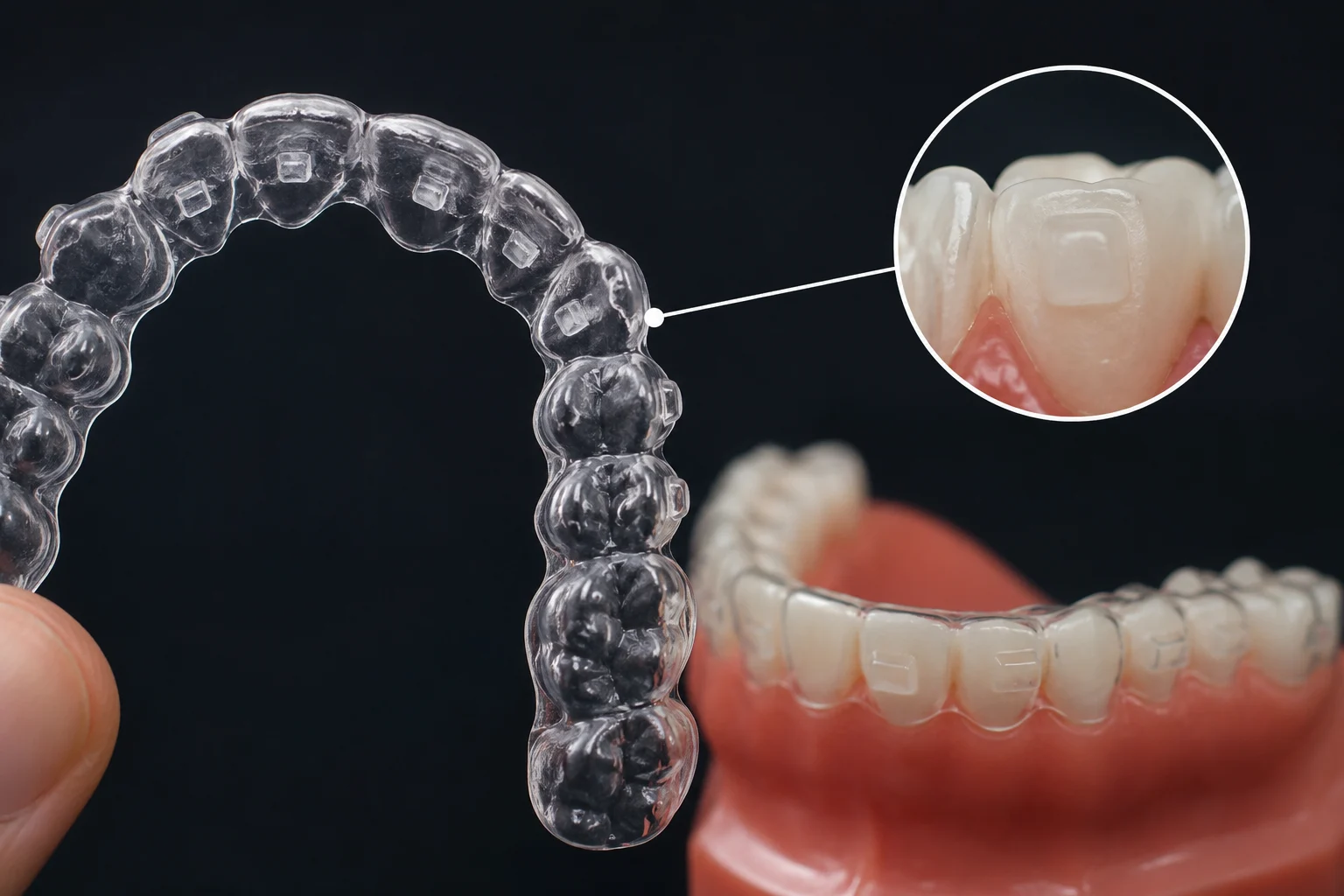
When patients at Fremont Star Dental learn they'll need Invisalign attachments as part of their treatment, the room goes quiet for a moment. Then the questions come: Will people see them? Will they hurt? Are they permanent?
These are completely understandable reactions — and ones we've answered hundreds of times. The truth is, attachments are one of the most misunderstood parts of Invisalign treatment. Once patients understand what they actually are and how they work, most of the anxiety dissolves. This guide explains everything clearly so you know exactly what to expect.
Quick Answer on Invisalign Attachments
- What are Invisalign attachments? Small tooth-colored dots or shapes made from composite resin, bonded temporarily to specific teeth to help aligners move them more precisely.
- Why are they needed? Attachments give aligners extra grip and leverage to perform complex movements — rotation, extrusion, or tilting — that smooth trays alone cannot reliably achieve.
- Do all Invisalign patients get them? No. Whether you need attachments depends on your specific case complexity and treatment goals.
- Are they visible? They are tooth-colored and generally blend well, but they are noticeable up close. Most patients adjust quickly and find them far less visible than they anticipated.
- Do they hurt? No. The bonding process is painless, and while the first day may feel slightly unusual, attachments are not a source of ongoing discomfort.
- Can they fall off? Rarely, but yes. If an attachment comes off, contact your provider — it can be rebonded at your next appointment or sooner if needed.
What Are Invisalign Attachments?
Invisalign attachments are small, precisely shaped bumps of tooth-colored composite bonding material — the same type used in tooth-colored fillings — bonded directly to specific teeth during Invisalign treatment. They range in size from about 2–4mm and come in different shapes (square, rectangular, triangular, circular) depending on the type of tooth movement required.
They are sometimes called clear aligner buttons, though the two terms describe slightly different things: buttons typically refer to small flat anchoring points used for rubber bands or elastic attachments, while Invisalign attachments are shaped composite structures designed to interact with the aligner tray itself.
How Invisalign Attachments Work
Think of Invisalign attachments like small handles on a suitcase. Without them, an aligner can only push or pull a tooth in relatively simple directions — and only when the tooth has enough surface for the tray to grip. Attachments create specific contact points that allow the aligner to push, rotate, or torque a tooth from a precise angle and with greater control.
The shape and placement of each attachment is calculated by Align Technology's ClinCheck® software as part of your treatment plan. Your dentist reviews and approves each attachment's specifications before they're placed — nothing is guesswork.
What Are Clear Aligner Buttons?
Clear aligner buttons are small anchor points bonded to teeth or sometimes to the aligner itself, typically used when rubber bands (elastics) are needed to correct a bite issue. Buttons are often circular and smaller than standard attachments, and they may be used in conjunction with other attachment types to manage horizontal jaw movement or significant bite correction.
Why Do Some Patients Need Invisalign Attachments?
Aligners work by fitting snugly over your teeth and applying controlled pressure. But not all tooth movements respond equally to that kind of uniform pressure — some require a more targeted approach.
Moving Difficult Teeth
Certain teeth are simply harder to move with aligners alone. Canines (the pointed teeth on either side of your front four) have long, conical roots that resist tipping movements. Molars have broad, flat crowns with minimal surface variation for an aligner to grip. Attachments placed on these teeth give the aligner specific purchase points to execute the intended movement more predictably.
According to the American Association of Orthodontists (AAO), the predictability of orthodontic tooth movement depends directly on the quality of the force delivery system — which is precisely why attachments matter in complex cases.
Improving Tooth Rotation
Rotational movements — spinning a tooth around its vertical axis to bring it into alignment — are among the most mechanically challenging things an aligner can accomplish. A smooth, uniform tray has little ability to apply rotational torque effectively. Attachments placed on opposite sides of a tooth create a pivot point and allow the aligner to apply rotational force with much greater precision.
Correcting Bite Issues
Patients with overbites, underbites, or open bites often require attachments in combination with other mechanics (such as rubber bands or bite ramps) to achieve the bite correction needed alongside tooth alignment. If your treatment plan includes bite correction, attachments are a likely part of your protocol. Learn more about how Invisalign can address underbites and how treatment is customized by case.
Do All Invisalign Patients Need Attachments?
No — and this is important to understand. Whether you need attachments, and how many, depends entirely on the movements required by your specific treatment plan.
Patients with mild spacing or very minor crowding may complete Invisalign treatment without a single attachment. Others with more complex cases — significant rotation, extrusion (pulling a tooth down or up into correct position), or bite correction — may have attachments on several teeth simultaneously.
Your dentist determines attachment placement during treatment planning, not arbitrarily, but based on what the movements require. If attachments are recommended for your case, they're there because your treatment outcome depends on them.
Are Invisalign Attachments Noticeable or Painful?
The two concerns we hear most at Fremont Star Dental: Will people notice? Will they hurt?
On visibility: attachments are made from tooth-colored composite resin and blended to match your enamel shade. From a conversational distance, most people won't notice them at all. Up close — or on a bright video call — they may be visible as small bumps on certain teeth. They are significantly less noticeable than metal braces brackets, and most patients report that they stop thinking about them within the first week.
On pain: the bonding process is completely painless — no drilling, no injections. The composite is applied and hardened with a curing light in minutes. The first 24–48 hours may feel slightly strange as your tongue explores the new textures, but this is a sensation, not discomfort. Your aligners will fit over the attachments snugly, and within a day or two, most patients have fully adjusted.
How Are Invisalign Attachments Applied and Removed?
Placement takes place during an early appointment in your treatment — sometimes at your first fitting, sometimes slightly later depending on your plan. The process takes 20–30 minutes for most patients and involves:
- Lightly etching the tooth surface to help the composite bond
- Applying the composite resin in a small template mold
- Hardening the composite with a UV curing light
- Polishing to smooth any rough edges
Removal happens at the end of your treatment, when your dentist uses a gentle buffing tool to polish away the composite. This is also painless and leaves your natural tooth enamel intact. The same composite material is used in routine dental bonding — it has a well-established safety record, per the American Dental Association (ADA).
How to Care for Invisalign Tooth Attachments
Invisalign tooth attachments require a small adjustment to your cleaning routine, but nothing complex:
- Brush around each attachment carefully. A soft-bristle toothbrush and careful circular motion helps dislodge food particles that collect around the edges of attachments.
- Avoid sticky and hard foods. Caramel, gummies, and chewing ice can dislodge attachments. Remove aligners before eating — this protects both your trays and your attachments.
- Limit highly pigmented foods and drinks. Coffee, tea, and deeply colored foods can gradually stain composite resin over time, particularly if the aligners are out for extended periods. Rinse after consuming staining beverages.
- Follow your provider's oral hygiene protocol. If you'd like detailed guidance on keeping aligners and attachments clean, see our guide to cleaning Invisalign retainers and aligners.
Note: If an attachment falls off or cracks, don't try to repair it yourself. Contact your Fremont Invisalign provider to have it rebonded. Continuing treatment without a displaced attachment may reduce the effectiveness of that tooth's movement.
Common Myths About Invisalign Attachments
Myth: Attachments mean my Invisalign won't be invisible anymore. Reality: Tooth-colored composite blends with your enamel. At conversational distances, most people won't notice. They are dramatically less visible than metal braces.
Myth: Attachments make Invisalign painful. Reality: The placement process is painless. Some patients notice mild pressure from the aligner-attachment interaction during the first day of a new tray set — this is the same mild pressure felt with any aligner change.
Myth: If I need attachments, my case is too complicated for Invisalign. Reality: The opposite is often true. Attachments expand Invisalign's ability to treat more complex cases that simpler aligner systems cannot handle. The need for attachments reflects treatment ambition, not a limitation. Learn about what Invisalign can treat, including more challenging alignment issues.
Myth: Attachments damage your teeth. Reality: Composite bonding material is applied to the surface of enamel without drilling. Removal at the end of treatment leaves the tooth intact. The same materials are used in standard cosmetic bonding procedures performed daily in dental offices.
Invisalign attachments are a precise, evidence-based tool that allows dentists to accomplish tooth movements that smooth aligner trays alone cannot reliably achieve. Whether you need them — and how many — depends entirely on your individual treatment plan. They are tooth-colored, painless to place and remove, and designed to give your aligner the grip it needs to move each tooth exactly where it needs to go.
If you're considering Invisalign for adults or exploring options for a teenager, understanding attachments upfront removes one of the most common sources of hesitation. Most patients barely notice them after the first week.
Ready to find out whether attachments are part of your treatment plan? Schedule a free Invisalign consultation at Fremont Star Dental — we'll evaluate your case, walk you through what your plan would involve, and answer every question before you commit to anything.
Frequently Asked Questions on Invisalign Attachments
What are Invisalign attachments?
Invisalign attachments are small tooth-colored bumps of composite resin bonded to specific teeth during Invisalign treatment. They come in different shapes and sizes, each designed to create specific contact points that help aligners apply more precise force — enabling complex movements like rotation, extrusion, or torque that smooth trays cannot reliably accomplish on their own.
Do all Invisalign patients need attachments?
No. Whether you need attachments depends on the complexity of your case and the movements your treatment plan requires. Patients with mild spacing may complete treatment without any attachments, while patients requiring rotation, bite correction, or significant repositioning of specific teeth are more likely to need them. Your dentist determines this during treatment planning.
Are Invisalign attachments noticeable?
Attachments are made from tooth-colored composite resin designed to blend with your enamel. At normal conversational distance, most people won't notice them. Up close or under certain lighting, they may appear as small bumps on affected teeth. They are substantially less visible than traditional braces brackets, and most patients report quickly forgetting they're there.
Do Invisalign attachments hurt?
No. Placement involves no drilling or anesthesia — the composite is applied and cured in minutes. The first day or two may feel slightly unusual as you adjust to the new texture, but attachments are not a source of ongoing pain. The mild pressure you feel from your aligners after a tray change is normal and unrelated to the attachments themselves.
Can Invisalign attachments fall off?
Rarely, but it can happen — typically from biting into hard or sticky foods with attachments exposed. If an attachment comes off, don't panic. Contact your Fremont Invisalign provider to have it rebonded. Avoid continuing with the current tray set if the missing attachment is critical to that stage of movement — your provider will advise you.
How long do Invisalign attachments stay on?
Attachments remain on your teeth for the duration of treatment — until the movements they support are complete. Some may be removed and repositioned mid-treatment if your plan is adjusted or refined. At the end of treatment, all attachments are gently buffed away using a polishing tool, leaving your enamel intact.
How do I clean my Invisalign attachments?
Brush around each attachment carefully with a soft-bristle toothbrush after every meal, paying attention to the edges where food can collect. Rinse your aligners with lukewarm water before reinserting, and maintain your regular dental hygiene routine. Avoid whitening toothpastes on or near attachments, as they can cause the composite to appear discolored relative to your teeth over time.
Can attachments stain over time?
Composite resin can absorb pigment from coffee, tea, red wine, and other staining foods or beverages — particularly when aligners are out for extended periods. Rinsing after consuming pigmented foods and limiting extended exposure helps preserve attachment color. At the end of treatment, attachment removal also removes any surface discoloration, so long-term staining is primarily a cosmetic concern during treatment rather than a lasting one.